
Cat Litter and Litter Box Basics
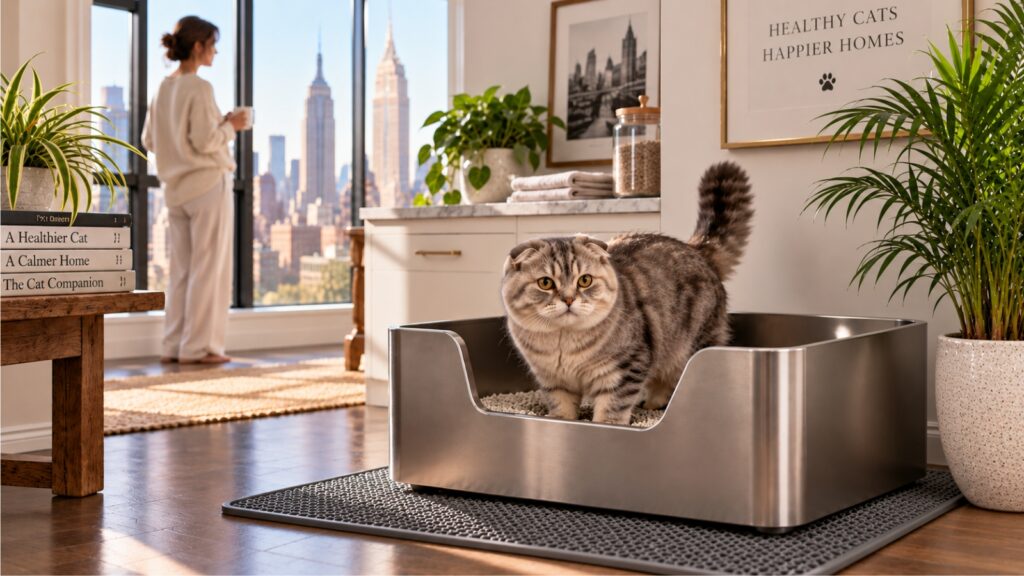
Why the Litter Box Matters for Cat Health
The litter box does more than manage waste. It is one of the few daily windows you have into what is happening inside your cat’s body.
Cats are remarkably good at hiding illness. That means changes in litter-box habits can sometimes be noticed before a cat appears obviously sick.
Kidney disease is a good example. Chronic kidney disease becomes increasingly common as cats age, and estimates vary widely depending on the study and the age group examined, with some reports placing prevalence as high as 80 percent in cats over 15 (Cornell Feline Health Center; Grecu et al., 2025). Obvious signs such as weight loss and lethargy may not appear until the disease is well established, so a noticeable change in urine volume, frequency, or litter-box use can be an important clue that something has changed.
Lower urinary tract problems can also first become visible at the litter box. Estimates put this at roughly 1.5 to 2.2 percent of cats seen at veterinary clinics, most often as feline idiopathic cystitis or urolithiasis (PMC, Prevalence and risk factors of FLUTD, Chiang Mai). Straining, frequent trips with little urine produced, urinating outside the box, or blood in the urine deserve attention. Digestive changes matter too. Diarrhea, unusually hard stool, changes in stool frequency, or blood can provide clues about gastrointestinal or other health problems.
This is why hand-scooping matters.
When you scoop the box yourself, you have an opportunity to notice what is actually being produced each day:
- Is there more or less urine than usual?
- Are urine clumps suddenly much larger or smaller?
- Is your cat going more often?
- Has the stool become unusually soft or hard?
- Is there blood, mucus, or anything else that looks different?
You don’t need to diagnose anything from the litter box. You simply need to notice when your cat’s normal pattern changes.
That daily observation can give you information you would otherwise miss.
Choosing the Right Type of Cat Litter: Some Pros and Cons
No single litter works for every cat. Texture, odor, dust, and personal preference all matter.
Clumping Clay (Bentonite)
Pros: Easy to scoop, good odor control, widely available. Cons: Can be dusty and heavy, with a substantial environmental footprint.
Non-Clumping Clay
Pros: Absorbent and often inexpensive. Cons: Requires more frequent full changes and makes urine monitoring less precise.
Silica Crystals
Pros: Excellent moisture and odor absorption and long-lasting. Cons: Texture is disliked by some cats and it can be more expensive.
Corn, Wheat, or Grass-Based
Pros: Lightweight, biodegradable, and often low-dust. Cons: Some products can become less effective when damp, and some cats dislike the texture.
Pine
Pros: Lightweight, biodegradable, and generally low-dust. Cons: Pellet texture isn’t preferred by every cat and odor can vary by product.
Paper Pellets
Pros: Soft, low-dust, and useful for some kittens or cats recovering from procedures. Cons: Poorer odor control and no clumping.
Walnut Shell and Other Natural Litters
Pros: Some are biodegradable and available in clumping formulas. Cons: Texture and odor may not appeal to every cat.
Why Unscented Is the Best Default
When choosing a litter, unscented is the best place to start.
The 2021 AAHA/AAFP Feline Life Stage Guidelines note that litter preferences vary among individual cats, but that most adult cats prefer clumping litter and most prefer it unscented. Unscented clumping litter is particularly appropriate for cats with a history of urinary problems.
Cats have a highly developed sense of smell. A fragrance that seems pleasant or mild to us can be intrusive to a cat that must walk into the box and spend time digging and eliminating there.
Scented litter also creates a second problem: it can mask the very odors and changes that help an owner monitor the box.
A clean box should smell clean, not perfumed.
For that reason, Catacats recommends unscented litter as the default choice, preferably a low-dust litter that your cat readily accepts.
If your cat strongly prefers another texture, however, acceptance matters. The best litter is ultimately one your cat will consistently use.
Stainless Steel Litter Boxes: Why We Prefer Them
Plastic litter boxes are inexpensive and widely available, but they have a significant disadvantage: plastic wears.
Repeated scratching, scooping, washing, and exposure to waste can leave a plastic box increasingly scratched and difficult to clean thoroughly. Once the surface is heavily scratched, cleaning becomes harder because the material is no longer as smooth or intact as it was when new.
Stainless steel offers an important advantage.
It is smooth, non-porous, durable, and highly scratch-resistant. It can withstand repeated washing and does not absorb odors the way an aging plastic box can.
Research on the cleanability of surfaces used in food environments has found stainless steel easier to clean and sanitize than some polymer surfaces. That research isn’t a study of cat litter boxes specifically, but the material properties are directly relevant when choosing a surface that will be repeatedly exposed to waste and cleaning.
For a litter box, the practical advantages are straightforward. Stainless steel:
- Is easier to clean thoroughly
- Resists scratching
- Does not absorb odors
- Holds up to repeated washing
- Can remain a smooth, cleanable surface for years
The disadvantages are mainly higher upfront cost and greater weight.
For Catacats, the tradeoff is worthwhile.
A litter box is something your cat uses every day. Choosing a durable surface that can be cleaned thoroughly is an investment in long-term hygiene.
Getting the Size Right
Litter-box avoidance is rarely about a cat being difficult. Often, the box simply isn’t large enough.
The AAFP, ISFM, and AAHA guidelines recommend a box at least 1.5 times the length of the cat, measured from the nose to the base of the tail.
This gives the cat enough room to turn around, dig, squat, and choose a comfortable position.
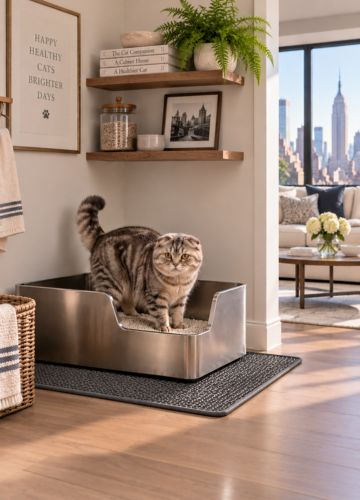
Many commercial litter boxes are smaller than this recommendation. Large cats, including Maine Coons, may need considerably more space.
High-sided boxes can help contain litter and urine while still allowing the cat plenty of room to move. Covered boxes aren’t automatically wrong, but they should not sacrifice size, ventilation, or easy access.
For multi-cat households, the general recommendation is one litter box per cat, plus one extra, with boxes distributed in separate, accessible locations.
The Cleaning Routine That Protects Your Cat
Scoop at least once a day, and preferably twice a day.
This is about much more than odor.
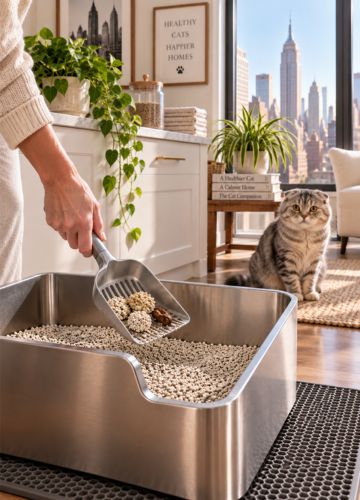
Every time you scoop, you can check your cat’s normal pattern.
You may notice:
Urine
- More or fewer clumps than usual
- Changes in clump size
- Frequent tiny amounts
- Unusual color
- Blood
Stool
- Diarrhea
- Constipation or unusually hard stool
- Changes in frequency
- Blood or mucus
- A significant change in appearance
A single unusual bowel movement doesn’t necessarily mean something is wrong. A pattern or sudden change is what matters.
A change in litter-box output is a reason to pay attention, not a diagnosis.
That’s one reason automatic removal can be less informative than hand-scooping: when waste disappears without you seeing it, you lose an important opportunity for daily observation.
Scooping and Toxoplasmosis
There is another reason prompt waste removal matters.
Infected cats shed Toxoplasma gondii in their feces. Newly shed oocysts are not immediately infectious; they need time to develop before they can infect people or other animals. The Companion Animal Parasite Council recommends removing cat feces from the litter box daily because oocysts generally require 1 to 5 days after being passed to become infectious (Companion Animal Parasite Council).
Removing feces promptly reduces the time oocysts have to become infectious. This is especially relevant in households where someone is pregnant or immunocompromised.
The risk of household transmission is generally low, particularly for cats that do not hunt or eat raw meat, but good litter-box hygiene is still a sensible precaution.
Clean the Box Regularly
Wash the litter box regularly with hot water. A weekly cleaning is a good goal, with frequency adjusted according to the litter, number of cats, and condition of the box.
With stainless steel, thorough cleaning is particularly straightforward.
Avoid litter-box liners if your cat dislikes them. They can shift, wrinkle, tear, and alter the surface under the paws.
What Should Never Be Used to Mask Litter-Box Odor
Don’t solve litter-box odor by adding more fragrance.
Avoid air fresheners, plug-ins, sprays, and heavily scented products around the litter box.
Avoid using household cleaners that leave strong residual odors or aren’t intended for surfaces used by animals.
Skip essential-oil products around cats. Some essential oils can be toxic to cats, and cats can be exposed through inhalation, skin contact, or grooming contaminated material.
Tea tree oil and several other essential oils are particularly concerning.
For routine litter-box cleaning, hot water and a mild, unscented soap followed by thorough rinsing are simple choices.
The goal is a box that is genuinely clean, not one that merely smells clean because fragrance is covering the odor.
The Problem With Automatic Litter Boxes
Automatic litter boxes can reduce the work of litter maintenance, but they have an important tradeoff:
You may lose your daily health check.
The value of scooping isn’t only removing waste. It’s seeing the waste.
A machine can remove a urine clump or stool without the owner ever seeing its size, consistency, color, or frequency.
Some modern systems record visits or estimate urine output, but those measurements don’t replace actually looking at what your cat is producing.
Automatic litter boxes also raise a separate safety issue: not every design is equally safe.
Some automatic litter boxes have raised legitimate safety concerns, particularly designs in which the entrance can become enclosed during the cleaning cycle if a safety mechanism fails. Safety features such as weight, motion, or pinch sensors are important, but owners should understand exactly how a particular model operates before allowing a cat to use it unsupervised.
If you already own an automatic box, examine the cleaning cycle carefully.
Ask:
- Can the cat enter the mechanism while it operates?
- Does the opening remain accessible?
- What happens if the cat enters during a cycle?
- Does the machine stop completely when resistance is detected?
- Can you still easily monitor the cat’s urine and stool?
Convenience should never come at the expense of safety or health monitoring.
In Conclusion
A good litter-box setup doesn’t have to be complicated.
Start with unscented litter that your cat accepts. Choose a box large enough for comfortable movement. For long-term durability and cleanability, stainless steel is an excellent choice. Keep the box clean and scoop it at least once a day, preferably twice a day.
Most importantly, look at what you’re scooping.
The litter box gives you a daily opportunity to notice changes in urine, stool, frequency, and bathroom behavior. Those changes don’t tell you what’s wrong, but they can tell you that something has changed.
And when it comes to cats, noticing a change is often the first step toward finding the right answer.
Catacats was created to make cat care clearer, safer, and less overwhelming.
Sources
- AAHA/AAFP Feline Life Stage Guidelines (2021), General Litter Box Considerations
- AAFP and ISFM Guidelines for Diagnosing and Solving House-Soiling Behavior in Cats
- Cornell Feline Health Center, Chronic Kidney Disease
- Cornell Feline Health Center, Toxoplasmosis in Cats
- Companion Animal Parasite Council, Toxoplasma gondii
- Grecu, M. et al. (2025), Epidemiology of Chronic Kidney Disease (CKD) in Cats, Life
- Prevalence and risk factors of feline lower urinary tract disease in Chiang Mai, Thailand (PMC)
- Microbial investigation of cleanability of different plastic and metal surfaces used by the food industry
- Published reporting concerning safety problems with certain automatic litter-box designs
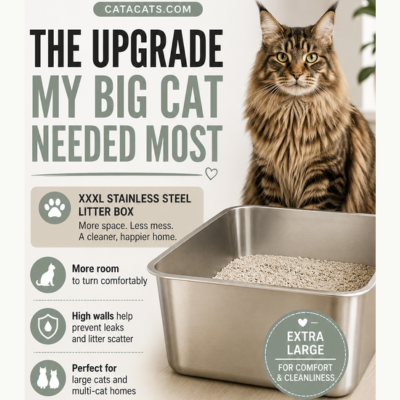
Stainless Steel Cat Litter Box
Stainless steel litter box with high sides. Easy to clean, durable and rust proof. 23.5″ X 15.6″ X 13″
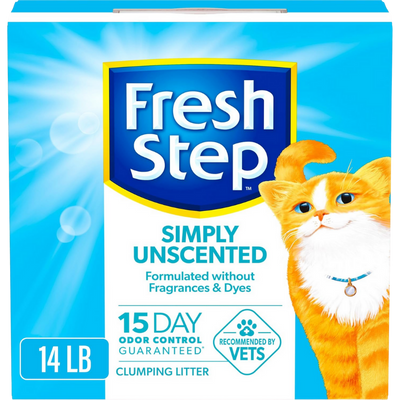
Unscented Clumping Litter
Pack of 3, 14 lb. boxes of Fresh Step Simply
Unscented Clumping Litter, activated charcoal kitty litter.
Learn More
Cat Basics: Understanding your cat’s natural instincts helps explain many common behaviors.
Vet Visits: Spaying, neutering, and smart, age-based veterinary care—learn how vaccines, titers, and regular checkups protect your cat at every stage of life.
Receive thoughtful updates, helpful tips, and sneak peeks at the upcoming Catacats guidebook.
Disclosure & Disclaimer: As an Amazon Associate, I may earn commission from qualifying purchases at no extra cost to you. All recommendations are based on research and experience to help you provide the best care for your cats. The information provided is for educational purposes only and is not a substitute for professional veterinary advice. Always consult your veterinarian regarding your cat’s health, diet, and care.