
The Language of Trust:
What Your Cat’s Love Really Looks Like
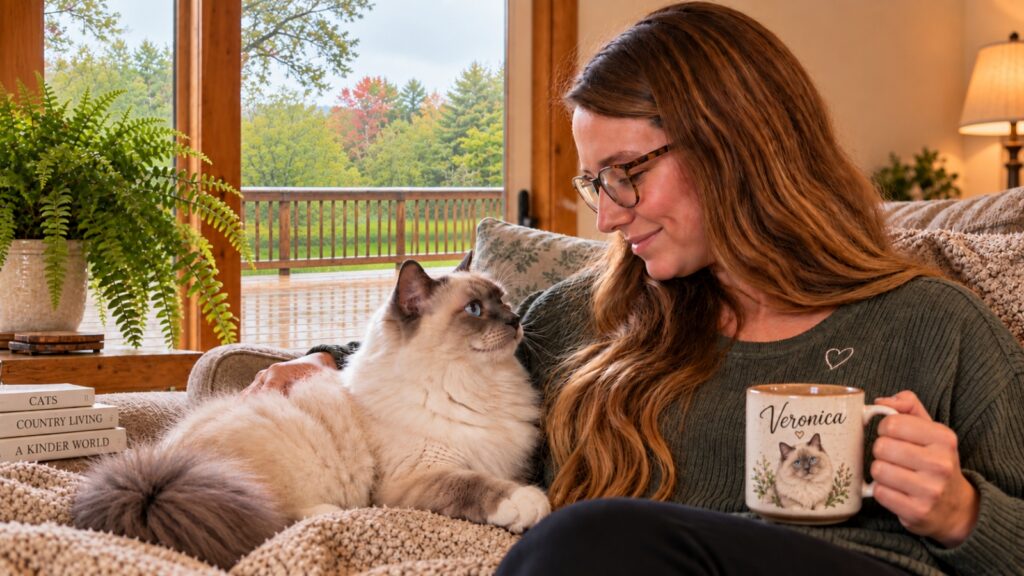
There is a moment every cat guardian knows. Your cat is curled nearby, and across the room, without a word, she turns her eyes toward you and slowly closes them. You do it back without thinking. Something passes between you in that half second, quiet and certain. That is not just sentiment. It is communication, and increasingly, science is helping us understand what cats may be expressing.
At Catacats, we believe the cat-human bond deserves to be understood, not just felt. When you know what your cat is telling you, you can meet her in the middle. That is where the deepest part of the bond begins: paying attention, then learning to trust one another.
Two Species, One Conversation
Cats have lived alongside humans for more than 9,000 years, but their domestication followed a different path from that of many other domesticated species. Researcher John Bradshaw, who has spent decades studying feline behavior, has described cats as essentially having domesticated themselves, drawn toward early human settlements by the rodents attracted to stored grain rather than being deliberately shaped by humans for obedience or cooperative work. Genetic research tracing domestic cats back to a wildcat population in the Near East supports this picture of a species that chose proximity to people on its own terms.
That history still shapes the relationship today. A cat’s relationship with humans developed differently from that of many domesticated species. A cat’s affection is not something we are entitled to. It is offered, and that makes it worth noticing.
Understanding a cat means learning a second language, one made of posture, distance, sound, scent, and timing rather than words. The good news is that researchers have studied this language, and the vocabulary is more knowable than most people realize.
The Signs of Trust
The slow blink
In 2020, researchers at the University of Sussex, led by Tasmin Humphrey and Karen McComb, ran the first experimental study of something cat owners had suspected for years. They found that cats respond to a human’s slow blink, a soft narrowing of the eyes followed by a longer closure, with slow blinks of their own. Cats were also more willing to approach an unfamiliar person’s outstretched hand after that person used the slow-blink interaction.

A follow-up study of shelter cats found that cats showing more and longer eye closures in response to human slow blinking were rehomed faster. The finding was an association, not proof that slow blinking itself caused cats to be adopted more quickly. Still, it added another piece of evidence that eye-narrowing may play a positive role in cat-human communication.
The researchers suggest that slow blinking may function as a form of positive emotional communication between cats and humans.
You can try it yourself. Wait until your cat is relaxed and looking your way, then soften your eyes and slowly close them for a second or two before opening them again. Avoid staring directly at her, and let her decide whether to respond.
If she returns the slow blink, you may have just participated in one of the clearest examples we have of a cat-human social exchange.
Soft floofs and the loaf
Watch a cat’s body when she feels safe. Instead of the tight, compact posture cats use when protecting themselves, a relaxed cat spreads out. Paws tuck loosely, the belly may show, the tail lies still or curls gently, and the whole shape of the body softens, almost melting into whatever surface she is on.
Behaviorists sometimes call this “loafing” when the paws tuck under, and the body rounds into a loaf shape. It can indicate that a cat is comfortable and relaxed.
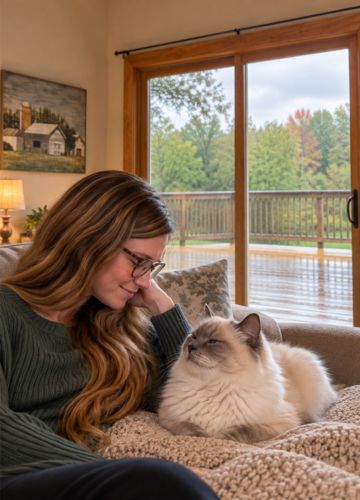
A note worth repeating often, because it saves cats and people real pain: an exposed belly is a sign of trust, not an invitation. It means she feels safe enough to be vulnerable in front of you. It is rarely an invitation to touch that vulnerable spot.
Reading the offer correctly, and not testing it, is itself an act of love.
Kneading, bunting, and the purr
Kneading, that slow, rhythmic pressing of paws, often against a soft blanket or your lap, is a behavior many cats carry over from kittenhood, when pressing against their mother’s belly helped stimulate milk flow. In an adult cat, it often appears in relaxed or comforting situations, a familiar behavior linked to early comfort.
Head bunting and cheek rubbing, sometimes called bunting or allorubbing, deposit the cat’s scent on you. Cats have scent glands around the face, and rubbing against people and other cats is part of how they create a familiar social scent within their environment.
When your cat bunts you, she is incorporating you into her familiar social world.
And then there is the purr. Cats can purr in a wide range of contexts, including when they appear relaxed, but also when they are stressed, frightened, or experiencing pain. The idea that purring promotes bone or tissue healing has attracted scientific interest because some of its frequencies overlap with frequencies studied in other biological contexts. Still, there isn’t enough evidence to say a cat’s purr heals injuries.
What we can say more confidently is that a purring cat can be deeply soothing to the humans who share its space.
Reading the Whole Cat
Trust signals only mean something in contrast to their opposite.
The American Association of Feline Practitioners and the International Society of Feline Medicine, in their Cat Friendly Veterinary Interaction Guidelines, describe how early stress in cats can show up subtly: ears rotating sideways or flattening, a slight lowering of the body, weight shifting back, changes in the eyes or face, and other small posture changes. These are quiet requests for space, easy to miss if you are only watching for dramatic signs such as hissing or a lashing tail.
Learning to notice these small, early signals, on both ends of the spectrum, is what lets you respond before a cat has to escalate to get your attention.
A cat that doesn’t have to fight to be heard learns that communication works. That lesson can deepen trust every time it is confirmed.
What Happens in You
The benefits of this bond aren’t just poetic. Research suggests that interactions between people and cats can influence measures such as cortisol, oxytocin, heart rate, and emotional state. However, effects vary by interaction type and by the individual cat and person. Some observational studies have also found associations between cat ownership and cardiovascular health, but these findings do not prove that having a cat directly prevents cardiovascular disease.
Something less measurable is also at play.
Caring for another creature who depends on you, and who chooses you back in return, gives shape to a day. It asks you to notice something outside yourself. A cat’s presence can interrupt the pace of a busy day with something remarkably simple: feed me, sit with me, notice me, let me sleep beside you.
That kind of attention matters, even when science cannot neatly measure every part of it.
Caregiving is quiet medicine. Not because a cat is a medical treatment, but because caring for another living being can give ordinary moments meaning, rhythm, and connection.
The Comfort of Iyashi
Cats feel so naturally comforting in our arms and in our homes for a reason. Their warmth, their weight, their softness, and the steady rhythm of a purr can invite us to slow down.
In Japan, the word iyashi (癒し) is associated with healing, soothing, and emotional restoration. It is a useful way of describing an experience many cat guardians recognize, without turning it into a medical claim.
A cat resting against your chest, purring low, asks nothing of you except that you stay still for a while.
In a life that rarely slows down on its own, that stillness is a gift.
Earning and Keeping the Trust
Trust is not a single gesture. It is built through hundreds of small, consistent choices:
- Let her approach first when possible, rather than reaching for her.
- Respond to a slow blink with one of your own.
- Notice an exposed belly as trust, not permission, unless she has taught you otherwise.
- Keep feeding, play, and rest on a rhythm she can predict.
- Give her a way out of every interaction. A door she can walk through if she wants to leave.
- Offer height, hiding spots, and scratching surfaces so she has some control over her environment.
None of this requires much.
It asks for attention and patience, offered without an agenda.
What Gets Lost When We Miss the Signs
When early stress signals go unnoticed, cats do not simply stay quiet about it. Over time, unaddressed fear and repeatedly pushed boundaries can contribute to withdrawal, avoidance, or defensive behavior. A cat may stop offering the relaxed behaviors that once signaled trust because those signals have not been respected.
Feline-friendly handling guidelines emphasize the reverse approach: recognizing subtle stress signals early, adapting the interaction, and giving the cat more control can reduce fear and help build trust during future veterinary care.
The lesson scales down easily to the living room.
A cat who is heard stays open. A cat who is repeatedly missed tends to close.
When Love Means Letting Go
This is the hardest form of love, and it deserves to stay simple rather than become more than it is.
When the time comes to say goodbye to a beloved cat, the kindest thing we can do is set our own fear and grief aside for a moment and let the decision be about their comfort and peace. Let love guide you more than worry does.
The clearest act of devotion is choosing what protects their dignity, even when doing so costs you deeply.
A Bond Worth Protecting
The relationship between cats and the people who care for them runs on attention paid in both directions.
Cats are telling us, constantly, in a language of blinks, posture, scent, sound, and distance, whether they feel safe. Learning to read that language, and to answer it honestly, deepens the bond rather than stall it.
Keep learning. Keep watching. Keep offering the slow blink back.
That quiet exchange, repeated over years, is what turns two separate species into something closer to family.
Sources & Further Reading
- Humphrey, T., et al. (2020). The role of cat eye narrowing movements in cat–human communication. Scientific Reports. Read the research
- Humphrey, T., et al. (2020). Slow Blink Eye Closure in Shelter Cats Is Related to Quicker Adoption. Animals. Read the research
- Driscoll, C. A., et al. (2007). The Near Eastern Origin of Cat Domestication. Science, 317(5837), 519-523. Read the research
- Rodan, I., et al. (2022). 2022 AAFP/ISFM Cat Friendly Veterinary Interaction Guidelines: Approach and Handling Techniques. Journal of Feline Medicine and Surgery. Read the guidelines
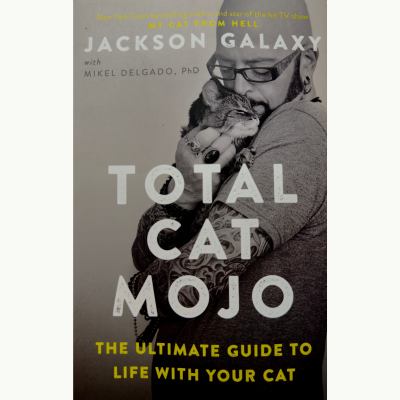
Total Cat Mojo
Comprehensive Guide
Love grows through education.
Fascinating humor-infused wisdom.
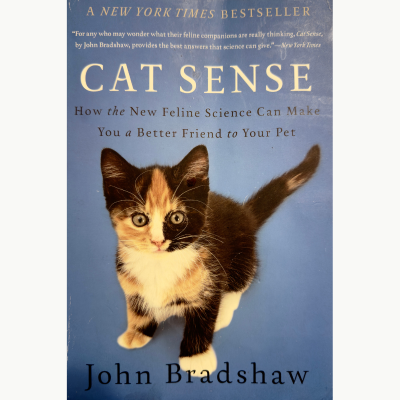
Cat Sense
Cutting Edge Science
NYtimes Bestseller. Cutting-edge research into the true nature of our feline friends.
Learn More
Toys: Interactive toys provide mental stimulation and help prevent boredom in indoor cats.
Cat Basics: Understanding cats as ancient predators—so care aligns with who they are, not who we expect them to be.
For the love of cats.
Get updates, fun tips, and sneak peeks at our upcoming Catacats Guidebook.
Disclosure & Disclaimer: As an Amazon Associate, I may earn commission from qualifying purchases at no extra cost to you. All recommendations are based on research and experience to help you provide the best care for your cats. The information provided is for educational purposes only and is not a substitute for professional veterinary advice. Always consult your veterinarian regarding your cat’s health, diet, and care.