
Cat Bowls and Feeding Setup: Best Practices
for Healthy Mealtimes
Nutrition isn’t just about what’s in the bowl. It’s also about the bowl itself and the environment around it. Cats evolved as solitary hunters with sharp instincts about safety, and small details in a feeding setup—the bowl’s shape, its placement, and even where the water sits relative to the food —can genuinely affect how much a cat eats and drinks.
Below are the most up-to-date, cat-centered recommendations for creating a healthier, happier mealtime routine.
Below is what current veterinary research supports, including a few widely repeated claims that don’t hold up as well as you’d expect.
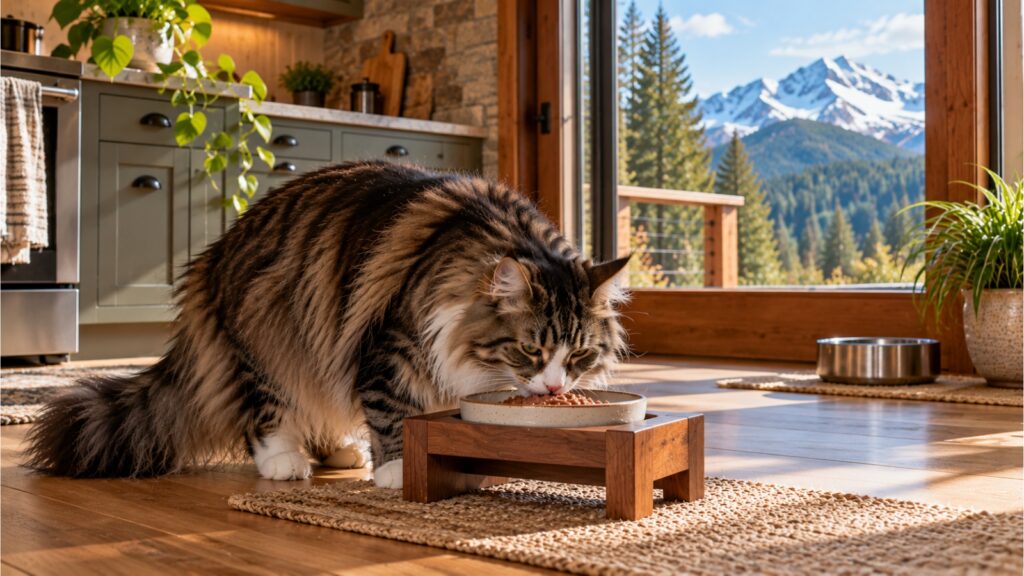
Feeding Environment Matters
Cats didn’t evolve to eat in groups or on a schedule set by someone else. The AAFP’s consensus statement on feline feeding notes that wild and feral cats may spend roughly 12 hours a day hunting and foraging, catching small prey frequently throughout the day rather than eating one or two large meals (AAFP, Feline Feeding Programs, 2018). Indoor life removes almost all of that natural foraging behavior, which the AAFP identifies as a real contributor to stress and overeating in pet cats.
Practical takeaways from the guidance:
- Place food away from foot traffic, loud appliances, and the litter box. The AAFP/ISFM Feline Environmental Needs Guidelines specifically call for food and water resources separate from toileting areas and from each other (Ellis et al., 2013).
- Offer small, frequent meals where possible, or use puzzle feeders and forage-style feeding to bring back some of that natural searching behavior.
- A stressed cat eats differently than a relaxed one, often too fast, too little, or not at all, so a calm location does real work toward a healthy appetite.
Multi-Cat Homes: Feed Separately
In a home with more than one cat, shared feeding stations create exactly the kind of competition cats aren’t built to tolerate well. The same AAFP/ISFM guidelines recommend at least two separate feeding areas in any multi-cat household, ideally out of sight of one another, so each cat can eat without guarding food or rushing through a meal (Ellis et al., 2013).
Separate stations also give you something useful: the ability to see exactly how much each cat is eating, which matters far more than most owners realize when it comes to catching an early change in appetite.
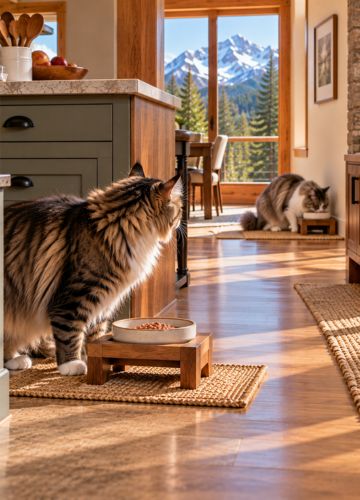
by another cat.
Bowl Material: What the Evidence Actually Supports
Stainless steel, glass, and lead-free ceramic remain the better choices, and the reasoning holds up. All three are non-porous, which means they don’t develop the microscopic scratches that trap bacteria and food residue the way plastic does over time.
Plastic’s connection to feline chin acne is real, but worth describing accurately. Veterinary dermatology sources describe plastic bowls as an implicated contributing factor rather than a single proven cause, since the exact origin of chin acne is still not fully understood (Veterinary Partner, VIN). What is well established is the mechanism: scratched plastic surfaces harbor bacteria that ordinary washing struggles to remove completely, and repeated contact between a cat’s chin and that surface is a plausible route of irritation. Switching to a non-porous bowl and washing it daily has helped resolve many mild-to-moderate cases, even without a definitive causal study.
Daily washing matters regardless of material. Biofilm, the thin bacterial layer that builds up in standing water and food residue, can form within 24 to 48 hours, well before a bowl looks dirty to the eye.
Elevated Bowls: A More Honest Look
Raised bowls are often recommended, with claims that they universally improve digestion and reduce regurgitation. The actual research is narrower than that.
The clearest clinical rationale for elevated feeding applies to cats with megaesophagus, a condition where the esophagus doesn’t move food normally. In these cats, gravity genuinely helps, and an elevated bowl is a legitimate part of managing the condition (Reinero et al., 2025). Elevation also provides real comfort for senior cats and cats with arthritis, since it reduces how far they have to bend to reach the bowl.
For an otherwise healthy cat, though, veterinary sources are candid that there’s no strong study proving elevated bowls improve digestion or reduce regurgitation across the board. If your cat is healthy and eats comfortably from a floor-level bowl, no evidence shows switching is necessary. If your cat is a senior, is arthritic, or has a diagnosed swallowing issue, elevation is worth doing and has real support behind it.
Where you do use one, keep the neck in a neutral position rather than bending down or reaching up:
- Small cats: 3 to 4 inches
- Average adult cats: 4 to 6 inches
- Large breeds, including Maine Coons: slightly taller as needed: slightly taller as needed to maintain a comfortable, neutral feeding position
Whisker Fatigue: A Popular Idea That Science Hasn’t Confirmed
This one deserves an honest correction, because it’s repeated as settled fact almost everywhere.
The idea behind whisker fatigue is that a cat’s sensitive whiskers become overstimulated by repeated contact with the sides of a narrow bowl, leading to stress or reluctance to eat. It’s a plausible-sounding theory given how sensory-rich a cat’s whiskers actually are. But the only controlled study to test it, published in the Journal of Feline Medicine and Surgery in 2020, found no measurable difference in eating time, food dropped, or food consumed between cats using a standard bowl and a wide, whisker-friendly one (Whisker stress evaluation, JFMS, 2020). No major veterinary organization currently recognizes it as a formal condition.
That said, the same study found that cats showed a modest, statistically significant preference for the wider bowl when given a choice, roughly a 74 percent likelihood of choosing it over the standard one. So while the stress-and-discomfort theory isn’t backed by evidence, cat preference for a wide, shallow bowl appears to be real on its own terms.
In practice, that means a wide, shallow bowl (roughly 6 inches across, with low sides) is still a reasonable default, simply because many cats seem to like it, not because narrower bowls have been shown to cause harm.
Water Placement and Hydration
Cats have a strong instinct to keep water sources separate from where they eat, likely inherited from an ancestor for whom water near a fresh kill could be contaminated. Placing water bowls several feet from food and offering water in more than one spot in the home respects that instinct.
Water fountains are where the popular advice runs ahead of the research. Fountains are marketed heavily on the idea that moving water reliably increases intake and dilutes urine enough to matter for urinary health. The most direct controlled study on this, published in the Journal of Feline Medicine and Surgery, found that a fountain did not significantly dilute urine in healthy cats, even though average measured water intake was somewhat higher (Grant, 2010). A separate pilot study comparing still and flowing water sources found no significant group-level difference in intake either. Individual cats vary widely. Some clearly prefer moving water and will drink more from a fountain; others are indifferent, and a small number are actively put off by it.
None of this means fountains are a waste of money, only that they shouldn’t be treated as a guaranteed fix for a cat who isn’t drinking enough. If hydration is a genuine concern, particularly for a cat with a history of urinary issues, feeding wet food is a far more reliably effective way to increase total water intake than any bowl or fountain choice, since moisture built into food doesn’t depend on a cat choosing to drink more (Buckley et al., PMC).
Hygiene and Safety Checklist
- Wash food and water bowls daily. A bowl that looks clean can still carry a meaningful bacterial load.
- Replace chipped or cracked ceramic bowls, since cracks harbor bacteria just like scratched plastic.
- Use a non-slip base or silicone mat to keep bowls from sliding while they eat.
- Avoid pushing bowls flush against a wall. Cats generally prefer a clear line of sight to the rest of the room while they eat, consistent with their instinct to stay aware of their surroundings.
- If you use a fountain, clean it at least weekly, following the manufacturer’s instructions, since pumps and filters are additional surfaces where bacteria can build up.
The Takeaway
A good feeding setup isn’t about chasing every trend in bowl design. It’s about a handful of things the research actually supports: a calm, separate location for each cat, non-porous bowls kept genuinely clean, elevation reserved for the cats who benefit most from it, and water offered in a way that respects a cat’s instincts rather than assuming a gadget will solve a hydration problem on its own.
Small, evidence-based choices add up. A well-designed feeding setup makes every meal calmer and safer, and it’s worth updating it periodically as new research emerges, even if that means letting go of a popular idea that didn’t hold up.
Sources
- American Association of Feline Practitioners, “Feline Feeding Programs: Addressing Behavioral Needs to Improve Feline Health and Wellbeing,” Journal of Feline Medicine and Surgery (2018)
- Ellis, S.L.H. et al. (2013), “AAFP and ISFM Feline Environmental Needs Guidelines,” Journal of Feline Medicine and Surgery
- Veterinary Partner (VIN), “Feline Acne”
- Reinero, C. et al. (2025), “Lower esophageal sphincter achalasia-like syndrome causing megaesophagus in a cat,” JFMS Open Reports
- “Evaluation of whisker stress in cats,” Journal of Feline Medicine and Surgery (2020)
- Grant, D.C. (2010), “Effect of water source on intake and urine concentration in healthy cats,” Journal of Feline Medicine and Surgery
- Pachel, C. and Neilson, J. (2010), “Comparison of feline water consumption between still and flowing water sources: a pilot study,” Journal of Veterinary Behavior
- Buckley, C.M.F. et al., research on moisture content and water intake in cats fed wet versus dry diets (PMC)
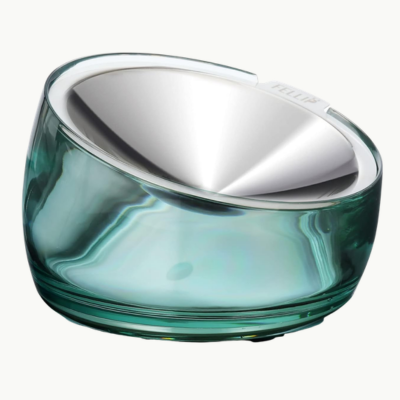
Stainless Steel
Elevated Cat Food Bowl
Under-bowl storage allows you to add ice, ice pad, or warm water to keep meals fresh. 4″L x 5″W x 5″H
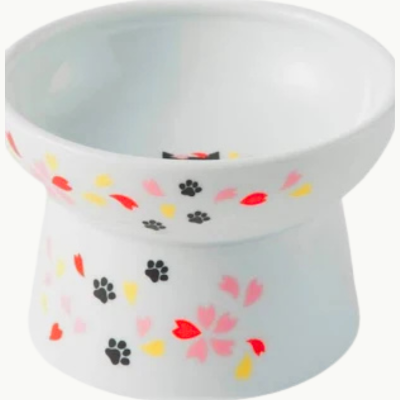
Ceramic Elevated 15° Tilted Bowl for Whisker Fatigue
Porcelain, free from lead and cadmium. Microwave and dishwasher-safe. 6.1″L x 5.7″W x 5.3″H
Receive thoughtful updates, helpful tips, and sneak peeks at the upcoming Catacats guidebook.
Disclosure & Disclaimer: As an Amazon Associate, I may earn commission from qualifying purchases at no extra cost to you. All recommendations are based on research and experience to help you provide the best care for your cats. The information provided is for educational purposes only and is not a substitute for professional veterinary advice. Always consult your veterinarian regarding your cat’s health, diet, and care.