
Cat Dental Care: Caring for Your Cat’s Teeth
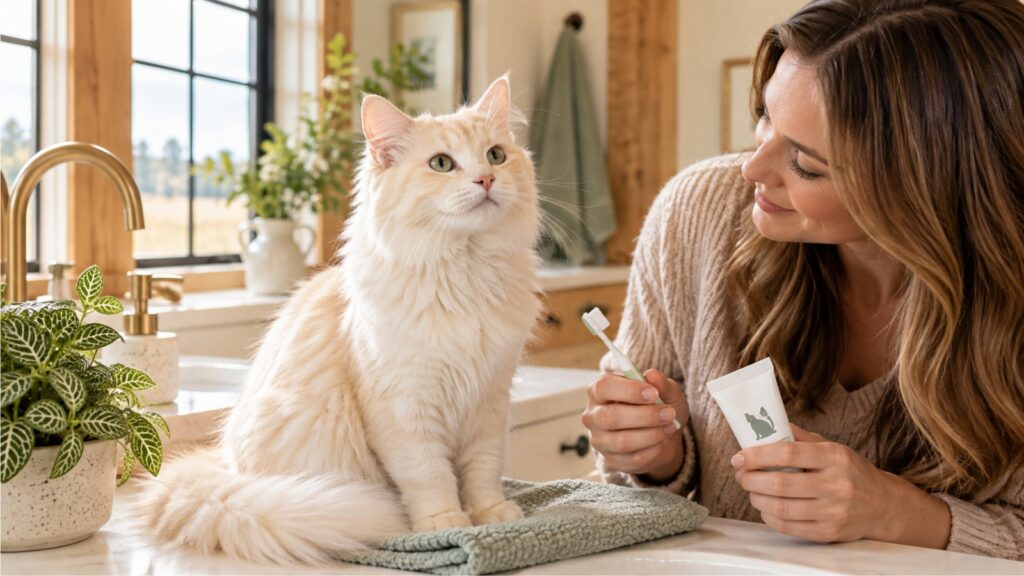
A Calm, Honest, Vet-Informed Guide to Feline Dental Health
When we think about keeping our cats healthy, dental care is often the last thing on the list, until something goes wrong. Yet your cat’s oral health affects far more than their mouth. Painful teeth and inflamed gums can affect eating, behavior, mood, and overall quality of life. And because cats are experts at hiding pain, many owners don’t realize anything is wrong until the problem is advanced.
The good news? Dental care doesn’t have to be stressful or complicated. It needs to start right, start early, and move at your cat’s pace.
Understanding Your Cat’s Teeth
Cats are obligate carnivores, and their teeth are built for grasping, tearing, and slicing, not grinding. Kittens have 26 baby teeth, which they replace with 30 adult teeth between about 3 and 6 months of age.
- Incisors, the tiny front teeth, help with grooming and nibbling.
- Canines, the long “fangs,” grasp and hold.
- Premolars and molars, the cheek teeth, work like scissors to slice food into swallowable pieces.
Cats don’t get enough mechanical cleaning from normal eating to prevent plaque and tartar buildup. Plaque and tartar can build up quietly, especially on the outer surfaces of the upper cheek teeth and canines, often with no obvious symptoms.
Why Dental Health Matters More Than You Think
Dental disease is one of the most common health problems veterinarians see in cats. Estimates suggest that most cats over age three have some degree of it. The main conditions include:
- Periodontal disease. Plaque bacteria cause gum inflammation (gingivitis). If left untreated, it can progress to infection and destroy the tissue and bone that hold teeth in place.
- Tooth resorption. This painful condition, in which the body breaks down its own tooth structure, affects a significant share of adult cats. It often hides below the gumline and can only be fully diagnosed with dental X-rays.
- Gingivostomatitis. A severe, painful inflammation of the mouth, likely driven by an abnormal immune response to plaque.
Research has found an association between dental disease and chronic kidney disease in cats, but this does not establish that one causes the other. Oral bacteria can also enter the bloodstream when gums are inflamed. The safest takeaway is simple: dental disease deserves attention because it can cause pain and damage to the mouth.
The Non-Negotiable Rule: Your Cat Must Like the Toothpaste
If your cat strongly dislikes the toothpaste, it will be very hard, if not impossible, to make brushing a positive routine.
A note from Rose, founder of Catacats: I learned this the hard way with my own Maine Coon, PeterBoo. Nothing worked until I found a toothpaste flavor he actually loved, and that required trying different brands and flavors. Once I did, brushing went from a battle to an enjoyable routine. Today, PeterBoo sits on the bathroom counter, waiting for his teeth to be brushed.
To your cat, the toothpaste can shape the entire experience. If the flavor is unpleasant, building trust and a positive routine becomes much harder. No technique, brushing method, or amount of patience can make up for toothpaste your cat strongly dislikes.
Watch for these signals that a flavor isn’t working:
- Squinting or narrowing the eyes
- Turning the head away
- Licking once and walking off
- Lip-licking, head-shaking, or drooling after a taste
If you see these, stop and try a different flavor. Cat toothpastes come in flavors like poultry, seafood, and malt for exactly this reason. Think of toothpaste as a reward, not a cleaning product. A cat who looks forward to the taste is far more likely to accept brushing.
The Second Key: Start Early and Go Slow
The easiest time to build a dental routine is kittenhood, when cats are naturally curious and open to new experiences. You can start offering cat toothpaste as a treat and gently handling their mouths as early as 8 to 12 weeks old.
One caution: between about 3 and 6 months, kittens are teething, and their gums can be tender. During this stage, stick to toothpaste licks and very gentle touches, and save real brushing for when the adult teeth are in.
Adult and senior cats can absolutely learn, too. It simply takes more patience. In every case, slow is fast. Rushing a single step can undo weeks of trust, while moving gradually builds a routine your cat accepts for life.
Important for adult cats: Before you start brushing, have your veterinarian examine your cat’s mouth. Brushing can’t remove existing tartar, and brushing a sore mouth hurts, which teaches your cat to fear it. If there’s disease present, a professional cleaning first gives you a clean, comfortable starting point.
Why Human Toothpaste Is Not for Cats
Never use human toothpaste on your cat. Cats can’t rinse and spit, so they swallow whatever you put in their mouths. Human toothpaste is formulated for people, not cats, and may contain ingredients or flavors that aren’t safe for cats.
What about dog toothpaste? Some veterinary toothpastes are formulated and labeled for both dogs and cats, and you can use those for cats. If a product is labeled for dogs only, choose a cat-specific or dog-and-cat product instead.
Simple rule: always choose toothpaste labeled safe for cats.
What to look for in a cat toothpaste
- Labeled for cats (or for dogs and cats)
- Enzymatic formulas, which help break down plaque-forming bacteria
- Flavors cats enjoy, such as poultry, seafood, or malt
- No fluoride, xylitol, foaming agents, or essential oils
Introducing Toothpaste the Catacats Way
Always start without a toothbrush.
- Choose a relaxed moment, such as during a cuddle or after a meal.
- Place a small dab of cat toothpaste on your fingertip.
- Let your cat sniff and lick it freely. Don’t hold them or force their mouth open.
- Watch their reaction.
If your cat licks it willingly and comes back for more, you’ve found the right toothpaste. If they walk away or squint, try another flavor. Give each flavor a fair chance over a few days before judging it. Many cats reject one flavor and love another, and this is completely normal.
Once your cat reliably enjoys the toothpaste, you’re ready to move forward.
Building Up to Brushing, One Step at a Time
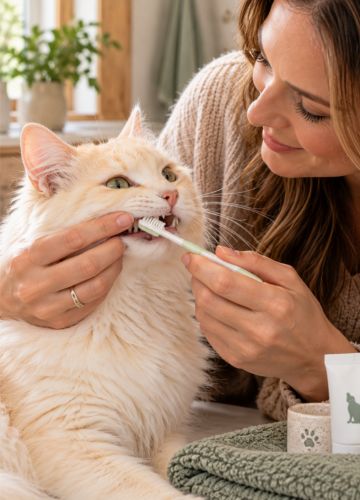
for both cat and owner.
Move to the next step only when your cat is relaxed with the current one. This may take days or weeks, and that’s okay.
- Toothpaste as a treat. Offer it daily until your cat looks forward to it.
- Touch the lips. Gently rub a toothpaste-covered finger along the outside of the lips.
- Touch the gums. Slide your finger under the lip and rub along the gums and outer teeth.
- Introduce a tool. Try a finger brush or a small piece of gauze wrapped around your finger.
- Introduce a soft cat toothbrush. Hold it at a 45-degree angle toward the gumline and use small, gentle circles.
Where to focus: Focus on the outer surfaces of the teeth, especially the back cheek teeth and canines, where plaque and tartar tend to accumulate. You generally don’t need to force your cat’s mouth wide open to brush effectively.
Keep it short: Aim for about 30 seconds per side. Always end on a positive note, with praise, a treat, or play, even if you only managed one tooth.
How often? Plaque begins accumulating quickly, so daily brushing is the gold standard. If daily brushing isn’t realistic, brush as often as your cat will tolerate. Any consistent brushing is better than none, but daily care gives the best plaque control.
Alternatives When Brushing Isn’t Possible
Some cats will never accept brushing, and that’s okay. Brushing is the most effective home care, but it isn’t the only option.
When choosing any dental product, look for the Veterinary Oral Health Council (VOHC) Seal of Acceptance. The VOHC reviews study data and awards its seal only to products shown to reduce plaque or tartar. You can find the current list of approved cat products at vohc.org.
Helpful options include:
- Dental diets. Specially designed kibble that mechanically cleans your cat’s teeth as it chews.
- Dental treats. Choose VOHC-accepted treats and count them in your cat’s daily calories.
- Food additives, such as kelp-based powders like PlaqueOff Powder.
- Water additives. Results vary, so choose VOHC-accepted products and introduce them slowly so your cat doesn’t stop drinking.
These work best alongside regular veterinary dental exams, and none replace professional care when disease is present.
Signs Your Cat May Have Dental Pain
Cats rarely show obvious pain. Watch for subtle changes such as:
- Bad breath
- Red line along the gums, or visible brown tartar
- Drooling, sometimes with blood
- Eating slowly, chewing on one side, or dropping food
- Preferring soft food or refusing dry food
- Pawing at the mouth or shaking the head
- Jaw chattering, especially when eating
- Reduced grooming or a messy coat
- Irritability, hiding, or other behavior changes
Any of these signs warrants a veterinary evaluation of your cat’s mouth.
Professional Dental Care
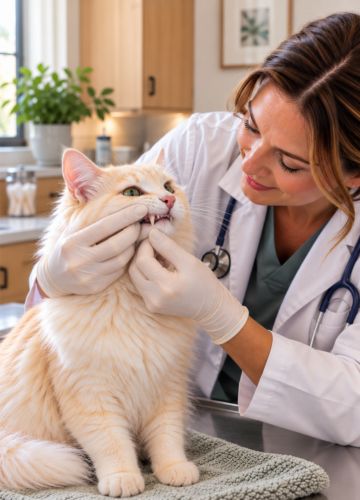
Your veterinarian should examine your cat’s mouth at least once a year, and more often for senior cats or those with a history of dental disease.
Why anesthesia is necessary. Proper dental cleaning requires examination and cleaning below the gumline, where important dental disease can occur. General anesthesia lets the veterinary team thoroughly examine the mouth, clean above and below the gumline, and take dental X-rays. Dental radiographs are particularly important in cats because conditions such as tooth resorption may not be visible above the gumline.
About anesthesia-free dental cleaning. The American Animal Hospital Association and other veterinary dental organizations do not recommend it. It can remove visible tartar but cannot provide a complete oral examination, safely clean below the gumline, or obtain dental radiographs, and it can give owners a false sense that their cat’s mouth is healthy.
Costs. Costs vary widely by region and by what your cat needs. A complete cleaning with anesthesia, monitoring, and dental X-rays commonly ranges from several hundred to well over a thousand dollars, and extractions add to that. Ask your veterinarian for an estimate. Consistent home care can reduce how often these procedures are needed and how involved they become.
Dental Care for Senior Cats
Older cats may be at higher risk for dental disease and may need more frequent dental evaluations. If a senior cat becomes hesitant to eat, loses weight, or stops grooming, consider dental pain.
Many owners worry about anesthesia for older cats. Age alone does not automatically rule out anesthesia. Your veterinarian can assess your senior cat’s individual health, perform appropriate pre-anesthetic testing, and determine whether dental treatment is appropriate. Untreated dental disease can also cause ongoing pain and other health problems, so weigh the risks and benefits for your cat.
Quick Answers to Common Questions
Does dry food clean my cat’s teeth?
Not in a meaningful way. Regular kibble shatters on contact, so it doesn’t scrub the teeth. Specially designed dental diets, ideally with the VOHC seal, can help.
Is it too late to start brushing my adult or senior cat?
No. Older cats can learn; it just takes more patience. Have your veterinarian check your cat’s mouth first, so you start with healthy, pain-free teeth.
Can I use baking soda or coconut oil instead of cat toothpaste?
It’s best not to. Baking soda tastes unpleasant to cats and is high in sodium, and there’s no good evidence that coconut oil prevents plaque, tartar, gingivitis, or periodontal disease. A cat toothpaste your cat enjoys is safer and far more effective.
What if my cat hates every toothpaste I try?
Keep trying different flavors and brands, since many cats reject several before finding one they love. If brushing still isn’t possible, VOHC-accepted dental diets, treats, or additives are good alternatives.
How often should my cat have a dental checkup?
At least once a year, as part of your cat’s regular wellness exam. Senior cats and cats with a history of dental problems may need more frequent checkups.
Is anesthesia for dental cleaning safe?
For most cats, the risk is low when anesthesia is planned and monitored carefully, though no anesthetic procedure is completely risk-free. Your veterinarian can assess your cat’s individual health, perform pre-anesthetic testing, and tailor monitoring to your cat’s needs. For medically indicated dental care, discuss the benefits and risks for your individual cat.
A Healthier Mouth, A Happier Cat
Dental care doesn’t need to be perfect. It needs to be kind, patient, and safe.
At Catacats, we believe success comes from working with your cat, not forcing them. Find a toothpaste your cat truly loves. Start early, go slow, avoid unsafe products, and partner with your veterinarian. Do that, and dental care becomes manageable, and sometimes even enjoyable.
Your cat’s comfort always comes first.
Sources
- American Animal Hospital Association (AAHA), Dog & cat dental disease: Signs, professional cleanings, anesthesia, and home care (updated January 26, 2026).
- American Animal Hospital Association (AAHA), 2019 AAHA Dental Care Guidelines for Dogs and Cats.
- AAHA/AAFP, Feline Life Stage Guidelines — Feline Dental Care.
- Veterinary Oral Health Council (VOHC), Accepted Products for Cats, current list.
- Veterinary Oral Health Council (VOHC), VOHC Seal of Acceptance.

Dental Care Kit for Cats
Appealing Malt Flavor
Everything you need to clean your cat’s teeth in one easy-to-use kit.

PlaqueOff Powder for Cats
Designed for feline palates
This cat breath freshener helps improve mouth odor over time as it works to reduce plaque and tartar.
Learn More
Nutrition: Diet plays a central role in your cat’s long-term health and energy.
Vet Visits: Preventive veterinary care helps keep cats healthy at every stage of life.
Receive thoughtful updates, helpful tips, and sneak peeks at the upcoming Catacats guidebook.
Disclosure & Disclaimer: As an Amazon Associate, I may earn commission from qualifying purchases at no extra cost to you. All recommendations are based on research and experience to help you provide the best care for your cats. The information provided is for educational purposes only and is not a substitute for professional veterinary advice. Always consult your veterinarian regarding your cat’s health, diet, and care.